Why Exposure and Response Prevention (ERP) Therapy Is So Effective for OCD + Anxiety
If you have spent years in therapy talking about your anxiety, unpacking your past, or trying to understand why your brain gets stuck on certain thoughts, you might be wondering why you still feel stuck.
You understand that your fears may not make sense. You recognize that you overthink things. You might even know that the reassurance you seek only helps for a little while.
And yet, the thoughts keep coming. The anxiety returns. The urge to check, analyze, avoid, or ask someone for reassurance feels almost impossible to resist.
Understanding your anxiety isn't the same thing as learning how to respond to it differently!
For people living with obsessive-compulsive disorder (OCD), traditional talk therapy alone may not address the patterns that keep the OCD cycle going. This is where exposure and response prevention (ERP) therapy can make a meaningful difference.
ERP is a specialized, evidence-based treatment for OCD that helps you practice facing uncertainty, responding differently to intrusive thoughts, and building a life that isn't dictated by anxiety.
Why Talk Therapy Doesn't Always Help OCD
Let's be clear: talking about your experiences can be incredibly valuable. Therapy can help you feel understood, process difficult experiences, recognize patterns, and develop self-compassion.
But OCD can be tricky.
OCD isn't simply a matter of having anxious thoughts or needing to think more positively. It often involves a cycle of intrusive thoughts, uncomfortable feelings, and compulsions intended to reduce distress or prevent something bad from happening.
For example, you might have an unwanted thought about accidentally hurting someone. You feel anxious, so you mentally review your actions, search your memory for evidence, or ask someone to reassure you that you're a good person.
You feel better for a little while. Then the doubt returns, and you feel compelled to figure it out all over again.
This cycle can happen with contamination fears, relationship doubts, fears of harming others, religious or moral concerns, and many other OCD themes.
When therapy focuses primarily on analyzing the thought, proving it wrong, or finding a way to feel certain, it can unintentionally become another place to seek reassurance.
You might leave a session feeling better, only to find yourself asking the same questions later that evening.
The problem isn't that you haven't thought about your anxiety enough. It's that OCD keeps convincing you that you need to do something about the uncertainty.
OCD treatment needs to address not only what you think and feel, but also what you do in response to those thoughts and feelings.
The International OCD Foundation's overview of ERP explains how this specialized approach differs from more traditional forms of psychotherapy.
What Is Exposure and Response Prevention (ERP) Therapy?
Exposure and response prevention is a specialized form of cognitive behavioral therapy (CBT) and a first-line psychological treatment for OCD.
ERP has two main components:
Exposure: Gradually and intentionally approaching the thoughts, situations, sensations, or uncertainties that trigger your OCD.
Response prevention: Practicing not engaging in the compulsions, rituals, avoidance, or reassurance-seeking behaviors you would normally use to reduce distress.
Together, these skills help you learn that you can experience anxiety and uncertainty without automatically responding to them with compulsive behaviors.
ERP isn't about forcing yourself to confront your worst fear all at once. It's a collaborative process in which you and your therapist identify meaningful treatment goals, develop a plan, and practice manageable steps at a pace that makes sense for you.
For a more detailed explanation, the International OCD Foundation's ERP treatment guide is an excellent resource.
How Does ERP Help Break the OCD Cycle?
Imagine that you have an intrusive thought that you might have left your front door unlocked.
Your anxiety spikes. You feel an overwhelming urge to go back and check. You might even replay the moment you left home in your mind, trying to remember whether you turned the lock.
Eventually, you check the door or mentally review the situation until you feel certain enough to move on.
The immediate relief teaches your brain that checking was necessary to feel safe. The next time the doubt appears, checking feels just as important.
ERP helps you practice a different response.
Instead of going back to check repeatedly, you might practice leaving the door after your ordinary locking routine and allowing the uncertainty to be there. You notice the urge to check without automatically acting on it.
At first, this may feel uncomfortable. You may experience anxiety, doubt, or the feeling that something is unfinished.
But you are learning something important: you can experience uncertainty without needing to resolve it.
With practice, you can develop greater flexibility in how you respond to intrusive thoughts and urges. You don't have to wait until you feel completely certain or calm before continuing with your day.
The goal isn't to guarantee that you'll never experience anxiety again. It's to help you respond to anxiety in ways that give OCD less control over your life.
The National Institute of Mental Health's guide to OCD provides additional information about OCD symptoms and evidence-based treatment options.
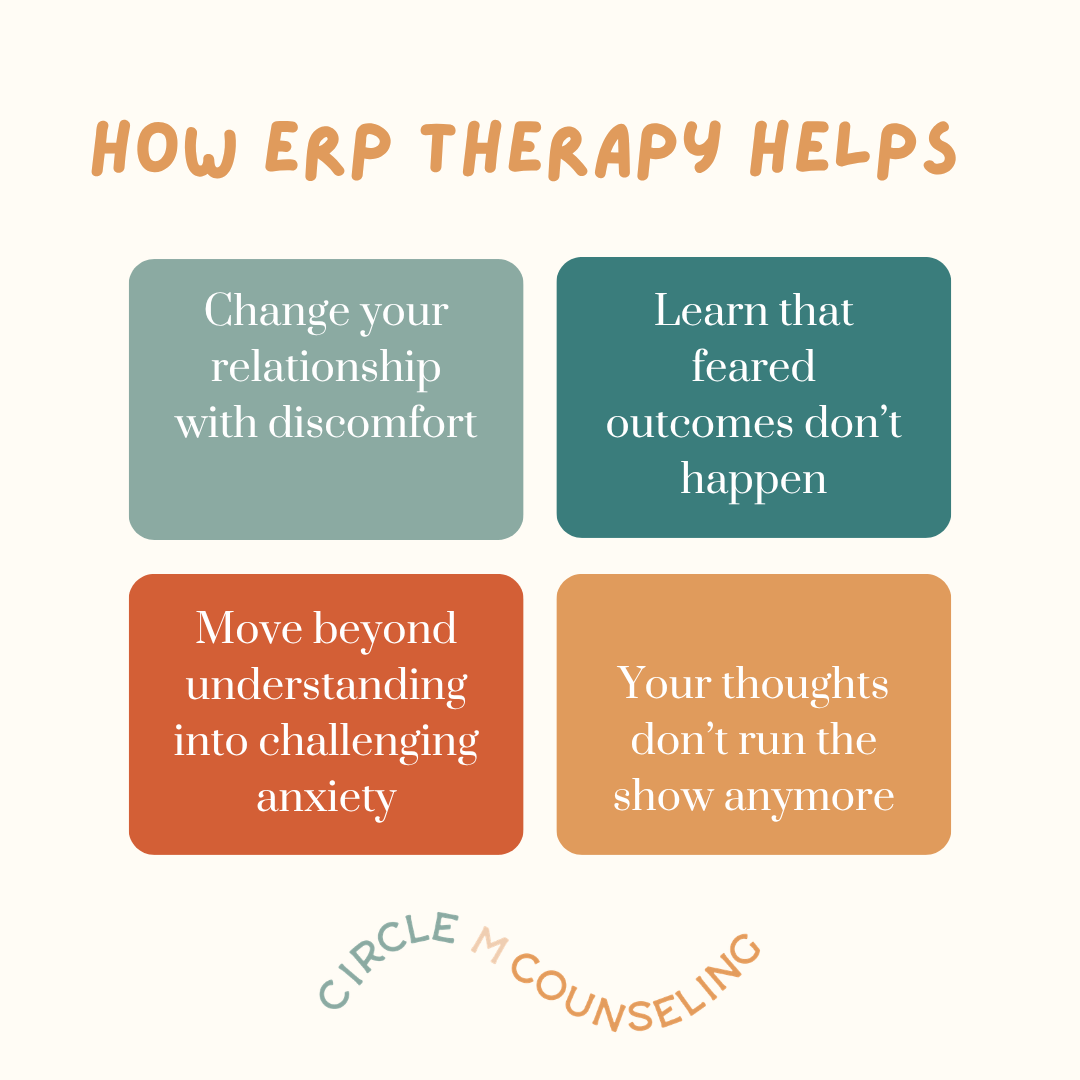
Here are just a few ways that Exposure Therapy helps OCD + Anxiety symptoms feel different in your life.
What Does ERP Therapy Look Like in Practice?
ERP is tailored to your specific symptoms, fears, values, and goals. There is no single exposure exercise that works for everyone.
Depending on your OCD symptoms, treatment might involve practicing how to:
Leave the house without repeatedly checking appliances or locks.
Resist the urge to ask a loved one whether you did something wrong.
Allow an intrusive thought to exist without mentally reviewing it for hours.
Sit with relationship doubts without repeatedly analyzing whether you are with the "right" person.
Encounter everyday uncertainties without searching the internet for reassurance.
Participate in meaningful activities even when anxiety tells you that you shouldn't.
Some exposures involve real-life situations. Others involve thoughts, images, memories, or uncertainties that cannot be resolved through a simple action.
ERP also involves response prevention outside the therapy session. Practicing new responses in everyday life is an important part of the process.
And no, ERP isn't about being reckless, ignoring genuine danger, or proving that your fears are impossible. It's about learning to distinguish reasonable precautions from the repetitive behaviors OCD demands in exchange for a feeling of certainty.
Your therapist should collaborate with you throughout treatment. You should understand the purpose of your exposures and have a voice in how treatment progresses.
What If I Have Anxiety but Don't Have OCD?
ERP is specifically associated with OCD treatment, but exposure-based approaches are also used for other anxiety-related difficulties.
For example, someone with social anxiety might practice speaking up in a meeting without excessively rehearsing every sentence. Someone who fears panic sensations might gradually practice allowing those sensations to occur without immediately escaping or engaging in safety behaviors.
The specific treatment depends on what is maintaining your anxiety.
Not every anxious thought is OCD, and not every anxiety concern requires the same approach. A therapist can help you understand what you're experiencing and determine whether ERP or another form of evidence-based treatment is appropriate.
The important thing is that treatment should help you build new ways of responding to anxiety, not simply give you more strategies for trying to eliminate every uncomfortable feeling.
ERP and ACT: Learning to Make Room for Uncertainty
In my work, I also draw on acceptance and commitment therapy (ACT), which complements the principles of ERP.
ACT encourages us to notice our thoughts and feelings without automatically treating them as instructions. Instead of spending all our energy trying to eliminate anxiety, we can practice making room for discomfort while moving toward the people, activities, and values that matter to us.
Think about the difference between these two questions:
"How can I make this thought go away so I can get on with my life?"
"Can I allow this thought to be here while I get on with my life?"
The second question opens up a different possibility.
You don't have to win an argument with every intrusive thought. You don't have to feel completely confident before making a decision. And you don't have to wait until anxiety disappears before doing something meaningful.
ERP gives you opportunities to practice responding differently to your fears. ACT can help you connect those choices to the life you want to live.
Together, these approaches can support a shift away from organizing your life around avoiding discomfort and toward making room for uncertainty while doing what matters to you.
What If I've Already Tried Therapy?
If you've been in therapy before and still struggle with OCD, it doesn't mean you've failed at therapy.
It doesn't mean you aren't trying hard enough, and it doesn't mean you are destined to feel this way forever.
You may have gained insight into your experiences without receiving treatment specifically designed to address your OCD symptoms. Or perhaps you've learned coping strategies that help temporarily but leave the underlying cycle intact.
It may be worth asking whether your previous treatment included ERP or another OCD-specific, evidence-based approach.
Finding the right treatment can take time, and ERP isn't a guarantee that every symptom will disappear. Progress varies from person to person, and treatment should be adapted to your needs. Medication may also be a useful option for some people.
If you're exploring specialized treatment, the International OCD Foundation's guide to finding the right therapist can help you identify questions to ask about a clinician's OCD experience and training.
You deserve treatment that addresses what you're actually struggling with.
Find OCD and Anxiety Treatment in Central Texas
You don't have to spend the rest of your life trying to outthink every anxious thought.
If OCD or anxiety is taking up too much of your time, affecting your relationships, or keeping you from doing things that matter to you, there are evidence-based approaches that can help you learn a different way forward.
I'm Bobbie Shae Melton, LPC, and I work with teens and adults experiencing OCD, anxiety, and related challenges. My approach incorporates evidence-based therapies, including ERP and ACT, to help clients practice responding to difficult thoughts and feelings with greater flexibility.
I offer virtual therapy throughout Texas, along with in-person therapy in Salado, Texas.
If you're ready to explore whether specialized OCD treatment might be a good fit, learn more about my OCD and anxiety therapy services or get in touch to discuss getting started.
You don't have to wait until you feel certain, confident, or completely free of anxiety to start building a life that matters to you.
About the author
Bobbie Shae Melton, LPC, is a Texas-licensed professional counselor providing virtual therapy throughout Texas and in-person therapy in Salado. Her work focuses on OCD, anxiety, eating disorders, and helping clients build psychological flexibility through evidence-based approaches.